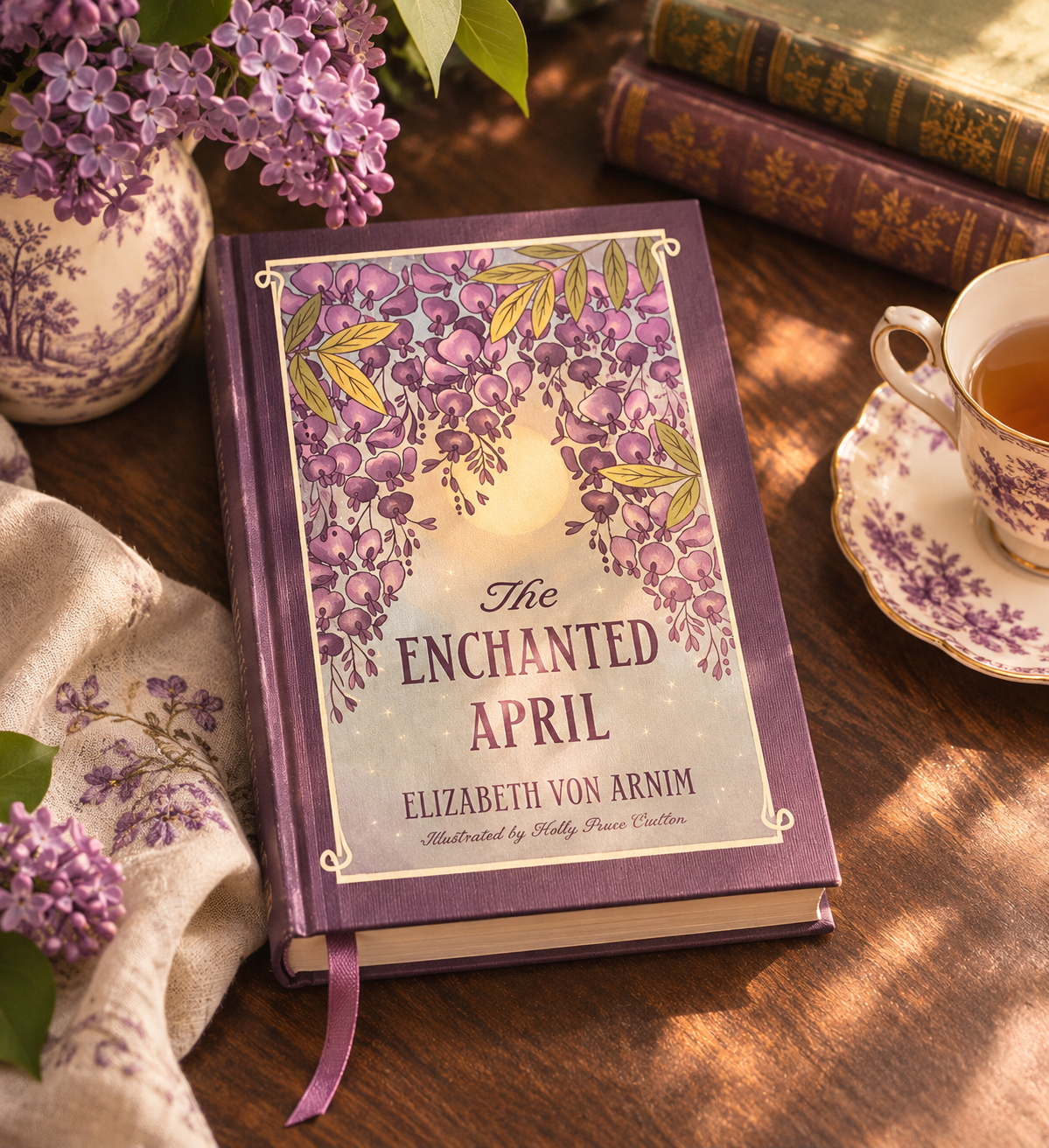
There is something rather curious about the things we envy in other people. We tend to imagine their advantages as uncomplicated blessings, forgetting that the person possessing them may have an entirely different opinion.
Beauty, for instance, is generally regarded as a considerable advantage in life. We admire it, pursue it, and occasionally spend a ridiculous amount of money attempting to acquire a little more of it. Surely, we think, a beautiful woman must enjoy the attention she receives. Surely there is something rather wonderful about being admired.
And yet, in Elizabeth von Arnim’s The Enchanted April, we encounter Lady Caroline Dester, a woman whose extraordinary beauty has become something of a nuisance.
Lady Caroline is accustomed to being admired. Wherever she goes, people notice her. Men are drawn to her, and her appearance inspires a degree of fascination that many women might secretly wish to experience just once.
But Lady Caroline has had quite enough of it.
She longs not for more admiration, but for the blessed relief of being left alone.
There is something wonderfully unexpected about this.
We are so accustomed to stories in which women wish to become more beautiful, more desirable, or more noticed that it is refreshing to meet one who would gladly exchange some of her considerable charms for a little peace and quiet.
And it raises an interesting question.
What happens when the very thing we believe would make us happy becomes the thing from which someone else longs to escape?
The Trouble with Being Seen
It is easy to confuse being admired with being known.
A beautiful woman may attract considerable attention without feeling that anyone has taken the trouble to discover who she actually is. People may be fascinated by her appearance while remaining remarkably uninterested in her thoughts, opinions, or character.
Lady Caroline’s beauty makes her visible, certainly. But visibility is not the same thing as understanding.
Indeed, one begins to wonder whether her beauty has become a sort of obstruction. People are so busy looking at her that they scarcely see her at all.
There is a quiet irony in this.
A woman who receives very little attention may imagine that beauty would solve her loneliness. Meanwhile, a woman who receives attention everywhere she goes may find herself longing for the simple pleasure of being treated as an ordinary person.
One wishes to be noticed.
The other wishes, for once, not to be.
And perhaps neither is asking for quite what the other imagines.
The Lives We Imagine for Other People
We have a peculiar habit of looking at another person’s circumstances and completing the story ourselves.
A wealthy woman must feel secure. A beautiful woman must feel cherished. A successful man must be satisfied. A happily married couple must never feel lonely.
We see the visible advantage and assume the invisible happiness.
But human lives are rarely so straightforward.
Beauty may attract admiration without affection. Wealth may provide comfort without contentment. Popularity may fill a room without producing a single meaningful friendship.
None of this means that beauty, wealth, or admiration are dreadful things. They may bring genuine pleasures and opportunities.
It simply means that their possession does not guarantee the feelings we associate with them.
And this is where Lady Caroline becomes particularly interesting.
She does not need to be taught that she is beautiful. She knows perfectly well what effect her appearance has upon others. What she needs is an opportunity to exist without constantly being defined by it.
Her retreat to Italy offers the possibility of something rather more valuable than admiration: the freedom to be herself.
The Curious Nature of Wanting
Perhaps the most revealing thing about Lady Caroline is not that she dislikes attention, but that she reminds us how thoroughly our desires depend upon our experiences.
Someone who has seldom been admired may find the prospect intoxicating.
Someone who has been admired all her life may find it exhausting.
Neither response is particularly mysterious when we consider the circumstances.
We often desire most intensely what we feel has been missing from our lives. And because we have experienced its absence, we may imagine its arrival as a kind of final resolution.
If only I were beautiful.
If only I were wealthy.
If only someone admired me.
If only I possessed that one elusive thing, I could finally be content.
But there is a difficulty with this way of thinking.
We are attempting to predict an entire emotional experience from the outside.
We imagine the pleasure of possessing something without fully understanding the complications that may accompany it.
And we overlook the possibility that the person who already possesses it may be looking wistfully in another direction.
A Different Kind of Beauty
One of the loveliest things about The Enchanted April is the way its characters begin to change when they are removed from their familiar surroundings.
In the sunshine and gardens of Italy, away from the expectations and disappointments of ordinary life, they have an opportunity to reconsider what they want and who they might become.
For Lady Caroline, this means something rather different from the transformations we might ordinarily expect.
She does not need to become more attractive or more interesting. She needs to discover what remains when she is no longer obliged to be the beautiful woman everyone admires.
And there is something quietly liberating in that possibility.
We spend so much of our lives trying to acquire qualities that will make other people value us. We want to be attractive, accomplished, clever, charming, successful, or indispensable.
Yet perhaps one of life’s greatest pleasures is finding a place where none of those accomplishments is required.
Where we may simply sit in the sunshine, enjoy the flowers, and be entirely ourselves.
Not admired.
Not evaluated.
Not compared.
Simply present.
A Parting Thought
I have always thought there is something valuable about encountering a character whose perspective is entirely different from our own.
Such characters remind us that our desires, however reasonable they may seem, are not universal truths.
The beautiful woman may wish to be overlooked. The wealthy man may long for simplicity. The person surrounded by admirers may envy someone who can walk into a room unnoticed.
And perhaps the next time we find ourselves envying another person’s circumstances, we might pause before assuming that their life contains the happiness we are seeking.
After all, the things we admire from a distance may look rather different to the people who live with them.
Perhaps the most useful question is not whether we would like to possess what someone else has, but whether we truly understand what it is we hope that possession would give us.
The Reading Room is a collection of literary reflections from Penrose House, exploring the curious things books reveal about human nature and the beauty of ordinary life.
For those who have ever closed a book only to find that the conversation was just beginning.