LESSON 1
The Art of Seeing
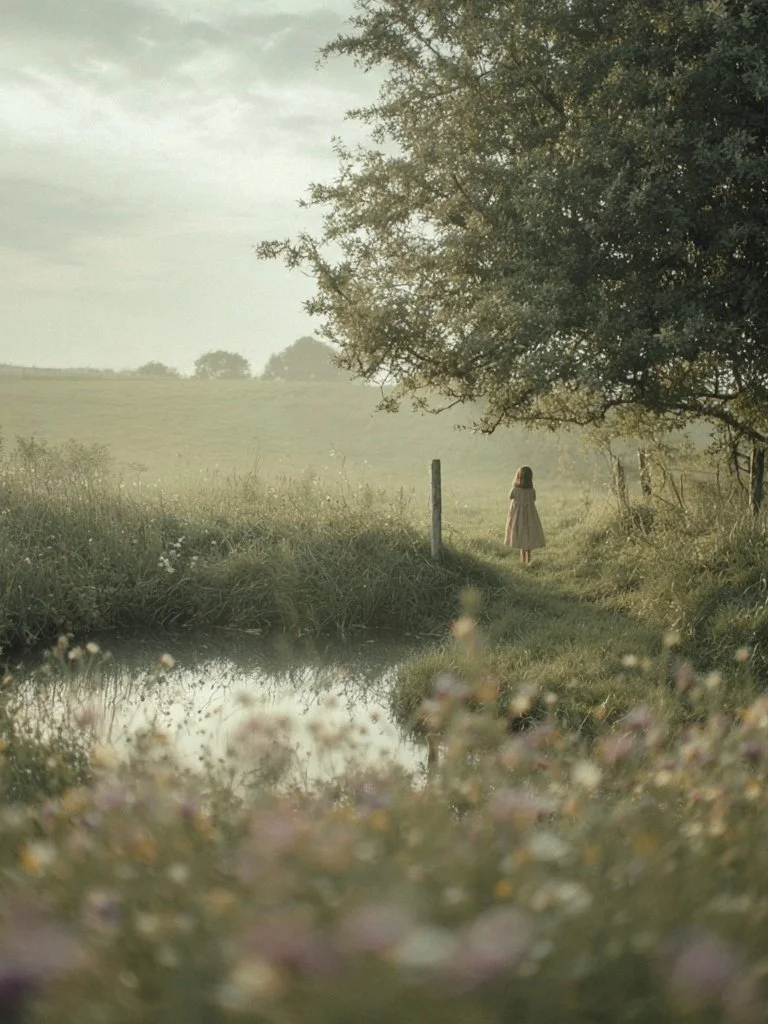
How to find something worth writing about in an ordinary day.
There is a lovely little secret about good writing: it often begins long before a single word is written.
It begins when we notice something.
Perhaps it is the way the morning light falls across the kitchen table, illuminating the steam rising from a cup of tea. Or the sight of a robin standing quite still in the garden, listening for something beneath the grass. Perhaps it is an old coat hanging by the door, its pockets still holding the small treasures of a day long past.
These are not remarkable events. They are the ordinary details of living.
And yet, in the hands of an attentive writer, they can become something rather wonderful.
Welcome to our first lesson in The Writing Circle. Today, we will begin with one of the simplest and most valuable skills a writer can develop: the art of seeing.
Looking Is Not Quite the Same as Seeing
We look at hundreds of things every day without giving them much thought.
We see the garden as we pass the window. We notice that it is raining. We glance at the trees and recognize that autumn has arrived.
But a writer learns to linger a little longer.
Instead of simply noticing that it is raining, she might observe how the raindrops gather along the edge of a leaf before falling, one by one, onto the dark earth below.
Instead of writing that autumn has arrived, she might notice a single yellow leaf caught in the branches of an otherwise green tree.
The difference is not that the writer has witnessed something extraordinary.
It is that she has given an ordinary thing her full attention.
This is the beginning of descriptive writing: choosing the particular details that allow someone else to experience a moment through your eyes.
The Difference a Detail Can Make
Consider this simple sentence:
The garden was beautiful that morning.
There is nothing wrong with it. We understand what the writer means. But we cannot quite picture the garden, can we?
Now consider:
The last of the roses leaned heavily over the garden path, their petals still holding the night's rain.
Suddenly, we can see something.
We know there are roses, that their blooms are growing heavy, and that rain has recently fallen. Without being told directly, we may even sense the quiet of an early morning.
Notice that the second sentence does not rely on complicated vocabulary. Its strength comes from choosing a few meaningful details.
This is an important lesson to remember:
Beautiful writing is not about finding the fanciest words. It is about finding the truest details.
Learning to Notice What Others Might Miss
One of the pleasures of writing is discovering that almost anything can become interesting when we look closely enough.
An ordinary afternoon might contain:
The uneven ticking of an old clock in a quiet room.
A little bird bathing in a puddle after the rain.
The faded place on a wooden table where someone has rested her hand for years.
The sound of dry leaves moving along a stone path.
A forgotten flower blooming behind the garden shed.
None of these details needs to become a grand story.
Sometimes a single observation is enough to begin a paragraph. Other times, it may awaken a memory, suggest a feeling, or lead us toward a thought we had not expected.
The important thing is to resist the temptation to hurry past it.
From Observation to Writing
Let us imagine that you have stepped outside one chilly morning and discovered frost across the lawn.
Your first observation might be:
There was frost on the grass.
A perfectly sensible beginning.
But now, linger.
What does the frost actually look like? Is it white, silver, or faintly blue? Has it settled evenly, or does it gather in particular places? What else do you notice about the morning?
Perhaps you discover that the frost is a delicate silvery green, spread across the fields while the distant hills still wear their autumn colors.
Now you might write:
The fields had taken on a silvery-green hue overnight, as though the morning had laid a fine veil across the grass. Beyond them, the hills still held their autumn colors, making the pale fields seem lovelier by contrast.
We have moved from a simple statement to a description that allows someone else to picture the scene.
And we have done it by asking questions, observing carefully, and choosing details that matter.
You do not have to include everything you notice. In fact, part of the art is deciding what to leave out.
Two or three well-chosen details will often create a stronger impression than a long list of everything in sight.
Your Writing Exercise: One Ordinary Moment
For this first exercise, you will need only ten minutes, a notebook or piece of paper, and a little curiosity.
Step One: Choose something ordinary.
Find a familiar place or object. It might be your kitchen window, a favorite chair, a tree in the garden, a cup of tea, or the view from your doorstep.
Choose something you can observe comfortably for a few minutes.
Step Two: Look a little longer.
Spend three minutes simply paying attention.
Ask yourself:
What do I notice first?
What small detail might I ordinarily overlook?
What colors, shapes, movements, or sounds are present?
Is there something surprising or particularly lovely about this moment?
What makes this scene different from another day?
Write down at least five observations. They need not be complete sentences.
Step Three: Choose your favorite details.
Read over your observations and select two or three that seem especially interesting.
Perhaps one makes you smile. Perhaps another brings back a memory. Or perhaps you simply find it beautiful.
There is no correct choice.
Step Four: Write a short paragraph.
Using your chosen details, write four to six sentences describing what you observed.
Try to help someone who was not there imagine the moment.
Do not worry about making it perfect. Do not search for impressive words. Simply write what you saw, as clearly and thoughtfully as you can.
Step Five: Read it once more.
When you have finished, read your paragraph slowly.
Ask yourself one question:
Can I see this moment when I read these words?
If the answer is yes, you have already begun to practice the art of descriptive writing.
If not, look for one more specific detail you might add.
That is all.
You have taken something ordinary, given it your attention, and begun turning it into a piece of writing.
A Final Thought
You may discover, as you continue writing, that the practice of noticing changes more than the words on your page.
The familiar world begins to offer up little surprises. A quiet room becomes interesting. A walk you have taken a hundred times reveals something new. Even the most ordinary day may hold a moment you would like to remember.
And perhaps that is one of the loveliest things about learning to write.
We begin by looking for something worth putting into words.
And along the way, we discover how much there is worth seeing.
Until next time,
The Writing Circle at Penrose House
Coming Next: Lesson Two — Finding the Right Words
In our next lesson, we will explore how sensory details and carefully chosen language can help bring your observations to life.
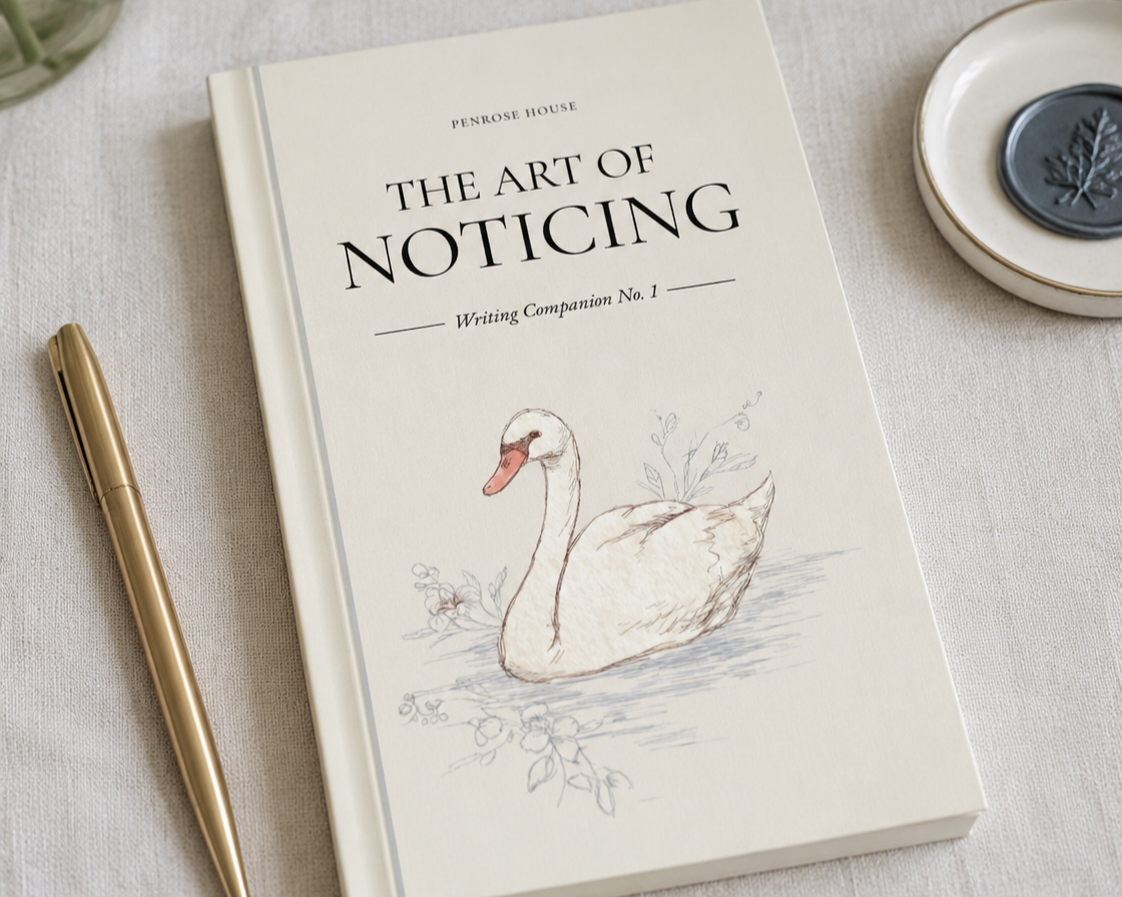
Continue the Art of Noticing
If you've enjoyed this first lesson and would like to explore the art of noticing a little further, you may enjoy The Art of Noticing — Writing Companion No. 1, from Penrose House.
Filled with original reflections, gentle writing invitations, and illustrations, this literary companion is designed to be enjoyed alongside your own notebook. It offers a quiet place to practice observing, remembering, and finding the words for the little things that make a life beautiful.